
ICE RAIDS GOLF COURSE FLOCK THAT NEVER MIGRATED IN FIRST SWEEP OF OPERATION MIGRATION COMPLIANCE
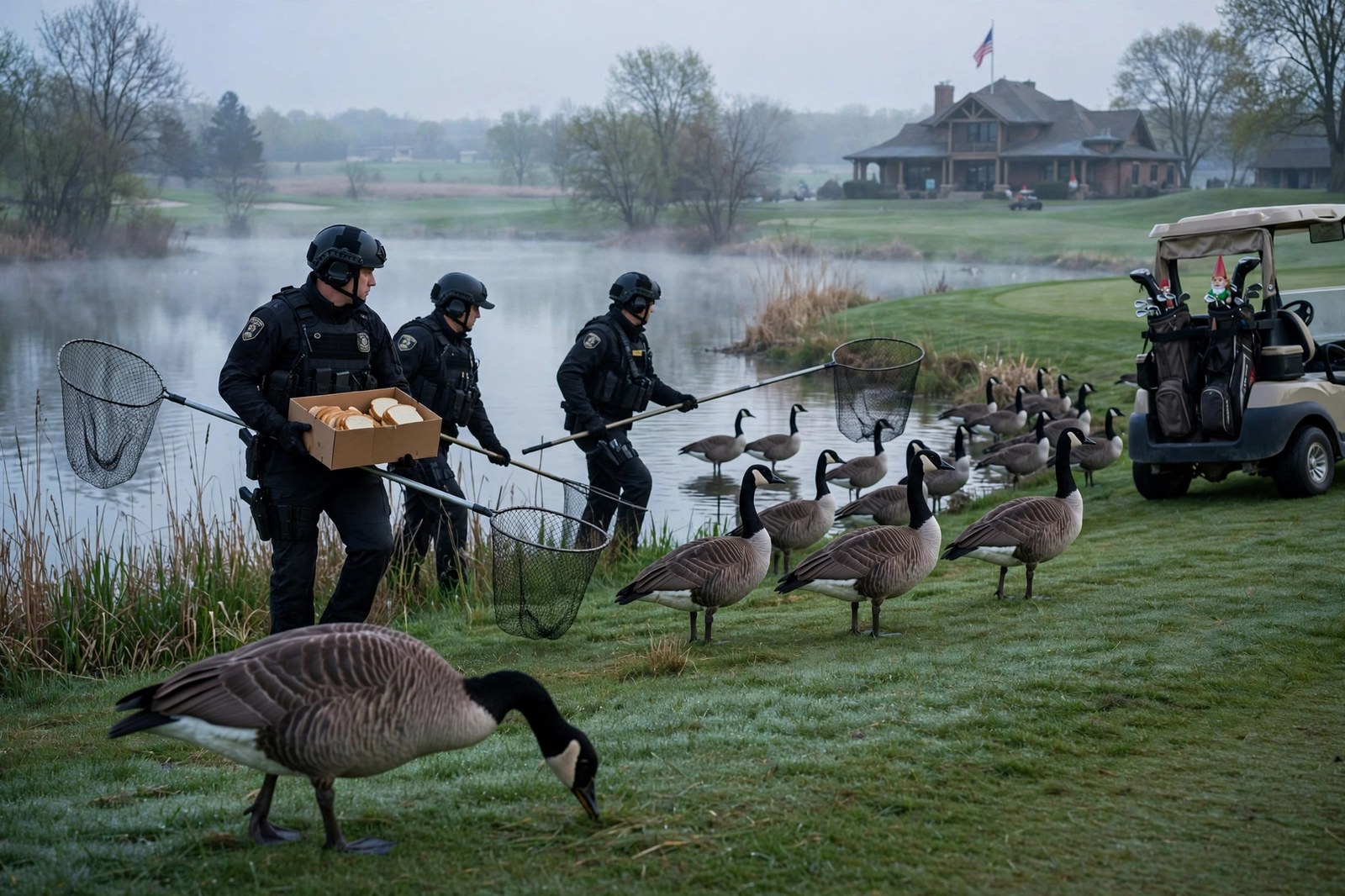
ANKENY, Iowa — Federal agents detained 47 Canada geese at dawn Tuesday at a municipal golf course pond, in the first enforcement sweep of Operation Migration Compliance, a Department of Homeland Security initiative targeting waterfowl that have failed to migrate.
Agents arrived in unmarked vehicles shortly before the first tee time and secured the pond, the practice green, and a sand trap in which several geese were later described as “loitering with intent.” The geese offered no resistance. Several honked. One continued eating.
“State and federal wildlife agencies have been banding and tracking these birds for decades,” a DHS spokesman said. “We’re using those records to get the ones who won’t self-deport.”
According to the department, the flock had been given until October 1 to depart for Canada. None did. The spokesman said the department considers the matter straightforward: the birds are Canada geese, they are not in Canada, and their presence in Iowa outside the approved season constitutes a continuing violation.
Wildlife officials offered a more complicated account. Most of the geese at suburban ponds and golf courses, they say, are classified in federal regulations as “resident Canada geese” — birds that nest in the continental United States and remain there from April through August. Many descend from geese stocked and transplanted by government wildlife programs beginning in the 1930s to rebuild depleted populations. Raised at the ponds where they were released, they were never taught a migration route.
“The department is aware of the stocking history,” the spokesman said. “Ignorance of the route is not a defense. The route is north.”
The sweep also netted 23 goslings hatched at the pond this spring. DHS has designated them “anchor goslings” and says their status is under review, on the grounds that a claim based solely on having been born at the pond would reward the parents’ non-departure. The goslings, who cannot fly, were released into the custody of the flock pending adjudication, which the department acknowledged could take until they are old enough to be deported for not leaving on their own.
In a second action Tuesday, agents took eleven domestic geese from a farm outside town. The geese, of a breed developed over centuries of farm husbandry, are physically incapable of sustained flight. Each was nevertheless classified as a flight risk. The department cited wingspan, a documented history of charging mail carriers, and what it called “a general attitude.”
“Their owner can petition for their return from Canada,” the spokesman said.
Canada has not agreed to accept them. The domestic geese were purchased from a hatchery in Missouri and have no connection to Canada. Canadian officials declined to comment, except to note that the geese are, in the words of one official reached by telephone, “not ours.”
At a briefing later in the day, reporters asked the Department of Justice to reconcile the operation with federal law under which the Canada goose is a protected species, and to state what the department does when hunters kill geese born at ponds like this one.
“Nothing,” the DOJ spokesman said. “That’s not a crime. That’s a season.”
He noted that states conduct a special early hunting season each September directed specifically at resident geese, with daily limits as high as fifteen birds, and that lawful hunting under the Migratory Bird Treaty Act is an authorized taking. Unauthorized taking is a federal offense. The department this year prosecuted a man in this same district who drove into a Canada goose with his car; he received six months’ probation and a $2,000 fine for the single bird.
Asked how a goose is to know which federal status applies to it on a given day, the spokesman referred reporters to the published season dates.
As of Wednesday morning, removal proceedings against the golf course flock had stalled, after Canada declined to confirm that birds hatched in Iowa are Canadian. The flock remains at the pond under an order of supervision. Golfers are advised to play through.
DHS says one goose remains at large. “We know where he nests,” the spokesman said. “It’s a matter of time.”
The Conversation. This story is discussed, disputed, and occasionally believed at our Facebook bureau, where the comments form part of the record.